Students
Biomedical Engineer wins Campbell Award
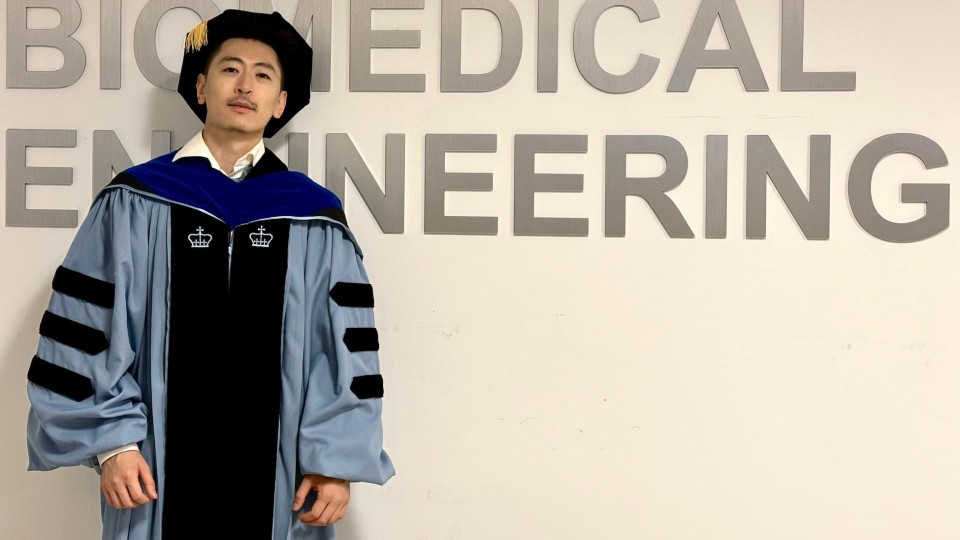
The Columbia Alumni Association selected PhD student Cheng “Gavin” Gong to represent Columbia Engineering in the 2026 Campbell Awards.
May 14, 2026
Cheng “Gavin” Gong is focused on making sure that engineering research benefits patients. A graduating PhD candidate, Gong stayed busy during his time in Morningside Heights, serving as a teaching fellow and as a member of the University Senate, where he co-chaired the Student Affairs and External Relations and Research Policy committees and sat on the Executive Committee.
Last month, Gong received one of the highest honors that a Columbia graduate can attain. The Campbell Award, which goes to one student from each school, recognizes graduates who show exceptional leadership and Columbia spirit.
Here, Gong reflects on his time at Columbia Engineering.
Why did you choose to concentrate in biomedical engineering?
I chose biomedical engineering because I’ve always wanted my work to be useful to people in meaningful ways. Over time, I realized I’m most motivated when what I’m doing can lead to real progress in science and healthcare, not just stay on paper. I see my research as a small but real contribution I can give back to the world, something practical and human-centered.
What's one project, class, or experience that stands out?
Looking back, every few months at Columbia brought new and exciting challenges that were worth thinking deeply about.One of my recent projects stands out, focusing on developing a scalable imaging platform that can be applied to biomedical discovery and, potentially, clinical settings. In many ways, it sits at the intersection of advanced microscopy and medical devices, with the goal of making high-resolution biological analysis more accessible.
What made this project especially exciting was its connection to AI in biology. We designed the system to enable large-scale data generation and integration with computational models, helping accelerate how biological insights are discovered and translated. Just a few days ago, my first-author paper on this work was accepted by Nature Biotechnology, which was a meaningful milestone for me. More than the publication itself, it was rewarding to see something we built from the ground up reach a point where it can contribute to the field.
What's something you worked on that you're especially proud of?
I’m especially proud of my experience as a Teaching Fellow for Biomedical Innovation I & II. Over that year, I worked closely with the professors and other fellows to create a more interactive and practical learning environment. We helped students take ideas from the lab and think through how to turn them into real, deployable products and bring them to market.
A lot of that work happened through brainstorming sessions, small group discussions, and building connections beyond the classroom, while thinking more broadly about impact. At the same time, I learned just as much from them, including their creativity, ambition, and courage to jump out of their comfort zones. I was nominated by my students for a Presidential Teaching Award. It was a reminder that teaching, at its best, is a two-way process of building ideas and community together.
How did Columbia Engineering shape your experience?
It changed how I think about impact. It also pushed me to think more proactively, not just solving problems. My goal is to position myself as an engineering leader who can scale up the impact of the environment around me and its contributions to society.
What's next?
I started working in venture capital focused on biotech and AI. At the same time, I’m trying to keep my engineering mindset, staying grounded in the science and focused on building things that can make a real difference.
What does it mean to be named a Campbell Award Winner?
It is a recognition of the kind of impact I strive to create, combining engineering, leadership, and service to improve the community around me. It also reinforces my responsibility to keep building and contributing to the broader community.
You balanced so much during your time at Columbia. How did these various roles impact you personally and professionally?
Balancing all these roles forced me to become a lot more resilient, because things rarely go as planned. It also shifted how I think, from just focusing on my own work to paying more attention to people and the systems around me. Along the way, I learned how to prioritize, execute, and deliver.
Fun fact about yourself that sums up your time at Columbia?
I like to joke that I’m a “choke dealer” on the jiu-jitsu mat. But what really defines my time at Columbia is the people. I was lucky to be supported by a very diverse group of friends, and that meant a lot to me.