Image
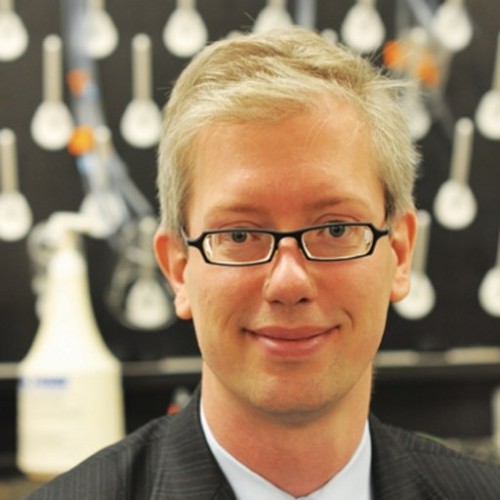
Henry Hess
Professor of Biomedical Engineering
Henry Hess focuses on engineering at the molecular scale, in particular the design of active nanosystems with biomolecular motors, the study of active self-assembly, and the investigation of protein-resistant polymer coatings.
He directs Columbia’s Hess Laboratory on Nanobiotechnology – Synthetic Biology and teaches two related courses: “Fundamentals of Nanobioscience and Nanobiotechnology” and “Current Topics in Nanobioscience and Nanobiotechnology”. His lab has used motor proteins in synthetic environments for the controlled transport of nanoscale cargo and continues to advance the design of such hybrid bionanodevices and materials. Applications for these hybrid systems can be found in medicine and biotechnology. They can also provide proof-of-concept for technological applications where temperature stability and durability are beyond the limitation of many components. Current areas of focus also include energy conversion and friction and wear.
Hess received a diploma in physics from Technical University of Berlin and in 1999, he earned a PhD in physics from Free University of Berlin. He was a research assistant professor of bioengineering at the University of Washington from 2002 – 2005 and an assistant professor of materials science and engineering at the University of Florida from 2005 until 2009 when he joined the biomedical engineering faculty at Columbia Engineering.
Research Areas
- Nanobiotechnology
- Nanorobotics
- Molecular Machines
- Single Molecule Imaging
Additional Information
-
Professional Experience
- Professor, Biomedical Engineering, Columbia University, 2016 - present
- Graduate Chair of Biomedical Engineering, Columbia University, 2020 - present
- Editor-in-Chief, IEEE Transactions on NanoBioscience, 2014 – 2019
- Associate Professor, Biomedical Engineering, Columbia University, 2009 – 2016
- Assistant Professor, Materials Science and Engineering, University of Florida, 2005 – 2009
- Research Assistant Professor, Bioengineering, University of Washington, 2002 – 2005
-
Professional Affiliations
- German Physical Society
- Alexander von Humboldt Association of America
- IEEE Engineering in Medicine and Biology Society
- American Chemical Society
-
Honor & Awards
- Columbia Faculty Mentoring Award, 2023
- Election to the American Institute for Medical and Biological Engineering (AIMBE) College of Fellows (Class of 2019)
- Invitation to the National Academies Keck Futures Initiative “Synthetic Biology,” 2009
- Distinguished Mentor Award of the UF/HHMI “Science for Life” program, 2007
- Philip Morris Forschungspreis (with Viola Vogel), 2005
- Feodor Lynen postdoctoral fellowship of the A. von Humboldt foundation, 2000, renewed 2001
- Wolfgang-Paul-Award of the German Society for Mass Spectrometry for best PhD thesis, 2000
- Erwin-Stephan-Award of the Technical University Berlin for outstanding graduates, 1996
- Scholarship from the “Deutsche Studienstiftung,” 1991-1993
-
Education
- Dr. rer. nat., Experimental Physics, Free University Berlin
- Diploma, Physics, Technical University Berlin
- Prediploma, Physics, Technical University Clausthal-Zellerfeld